
Waymo Launches in Denver: Survey Reveals Safety Concerns Among Residents
Home » Waymo Launches in Denver: Survey Reveals Safety Concerns Among Residents
Waymo began welcoming its first public riders in Denver on September 1, 2026, and has gradually expanded access to driverless rides. For people deciding whether to get in, safety is a primary consideration. How will the vehicle respond when something unexpected happens, and who’s responsible if it causes a crash?
A September 2026 survey commissioned by Olson Personal Injury Lawyers explored respondents’ views on Waymo in Denver, including their willingness to ride and concerns about passenger privacy. Safety was the most important factor in deciding whether to use Waymo for 61% of respondents. The findings also show interest in specific uses, such as getting home after drinking, alongside hesitation about trusting a vehicle without a human behind the wheel.
What the Survey Found About Waymo in Denver
- Respondents’ trust that Waymo would prioritize residents’ safety over the company’s financial interests averaged 3.8 out of 10.
- When rating how safe they would feel riding in a Waymo without a human driver, respondents had an average rating of 4.0 out of 10.
- On a scale with 0 being “extremely unlikely” to 10 being “extremely likely,” 41% rated their likelihood of using Waymo between 0 and 2.
- Of those surveyed, 61% identified safety as the most important factor in deciding whether to use Waymo.
- When asked if Waymo’s benefits outweighed its potential risks, only 28% believed Waymo’s benefits outweigh its potential risks, including 20% who said “somewhat” and 8% who said “greatly.”
Safety Concerns Remain a Barrier to Waymo Trust in Denver
According to those surveyed, 61% named safety their most important consideration. When asked about their trust that Waymo would prioritize residents’ safety over financial interests, responses averaged 3.8 out of 10. Additionally, perceived ride safety averaged 4.0 out of 10.
Waymo says it spent months testing its technology on Denver streets and working with first responders and community groups before welcoming riders. Its current safety data shows that serious or fatal injuries in the cities studied occurred in 95% fewer crashes than human-driver benchmarks over equivalent distances.
Meanwhile, respondents expressed different levels of comfort:
- “It’s terrifying. So it would not replace any transportation I currently use.”
- “My daughter rode in one and felt safe, so I see the car being able to navigate better than possibly a human being”
How Waymo’s Crash Rates Compare With Human Drivers
A 2026 Insurance Institute for Highway Safety (IIHS) study found that Waymo’s driverless vehicles had 68% fewer police-reportable crashes and 81% fewer injury crashes per mile than human drivers. The research covered San Francisco, Phoenix, Los Angeles, and Austin using data from 2021 through 2024.
Those findings don’t necessarily resolve individual hesitation. One respondent explained:
“I would feel as comfortable with Waymo as with certain human drivers (i.e., an inexperienced teenage driver).”
The study offers evidence of lower crash rates in the locations examined, but it doesn’t establish performance on Denver roads or in Colorado winter conditions. IIHS also identified gaps in federal crash reporting that make ongoing comparisons difficult. As Waymo expands, additional local data could help assess whether those safety results carry over to new operating conditions.
What Would Help Respondents Trust Waymo More?
When respondents were asked what would increase their trust in Waymo, safety data was the most selected answer. Transparent accident reporting and positive experiences in their communities also ranked highly, suggesting interest in both measurable performance and seeing the service work locally.
Answer
Safety data
Transparency in accident reporting
More positive experiences in my community
Third-party testing
Stronger government oversight
Nothing would change my opinion
Nothing, I already trust Waymo
Other
Percentage Respondents (%)
57
49
42
39
20
15
8
4
Safety Skepticism Appears Across Age Groups
Regarding Waymo’s perceived safety, average ratings were below the scale’s midpoint across all five age groups. Among respondents ages 55–64, ratings averaged 3.3 out of 10, and among respondents ages 45-54, ratings averaged 4.3 out of 10. An analysis of the responses found no statistically significant differences between age groups.
Respondents also expressed reservations about family members riding alone. When asked about their comfort level with allowing their child to ride alone in a Waymo, 68% felt somewhat or very uncomfortable. Additionally, 62% expressed discomfort about an elderly family member riding alone. These answers reflect respondents’ comfort levels, rather than evidence that either group faces greater risk.
Who Should Be Responsible if a Waymo Causes a Crash?
When asked who should be responsible if a Waymo causes a crash, 74% of respondents believed Waymo should be held responsible if one of its vehicles causes an accident. Respondents could select multiple answers.
Other answers included:
- 28% said responsibility should depend on the circumstances
- 26% selected the vehicle manufacturer
- 21% selected the software developer
- 3% were unsure
These tallies reflect the view that responsibility could be shared or depend on the circumstances of the crash.
Privacy Concerns Could Also Shape Acceptance of Waymo
Respondents were also concerned about passenger privacy. Concerns about the data Waymo vehicles might collect, such as passenger information, location, and trip data averaged 6.0 out of 10. That score was above the averages for trust in Waymo’s safety priorities (3.8 out of 10), perceived ride safety (4.0 out of 10), and likelihood of use (3.9 out of 10).
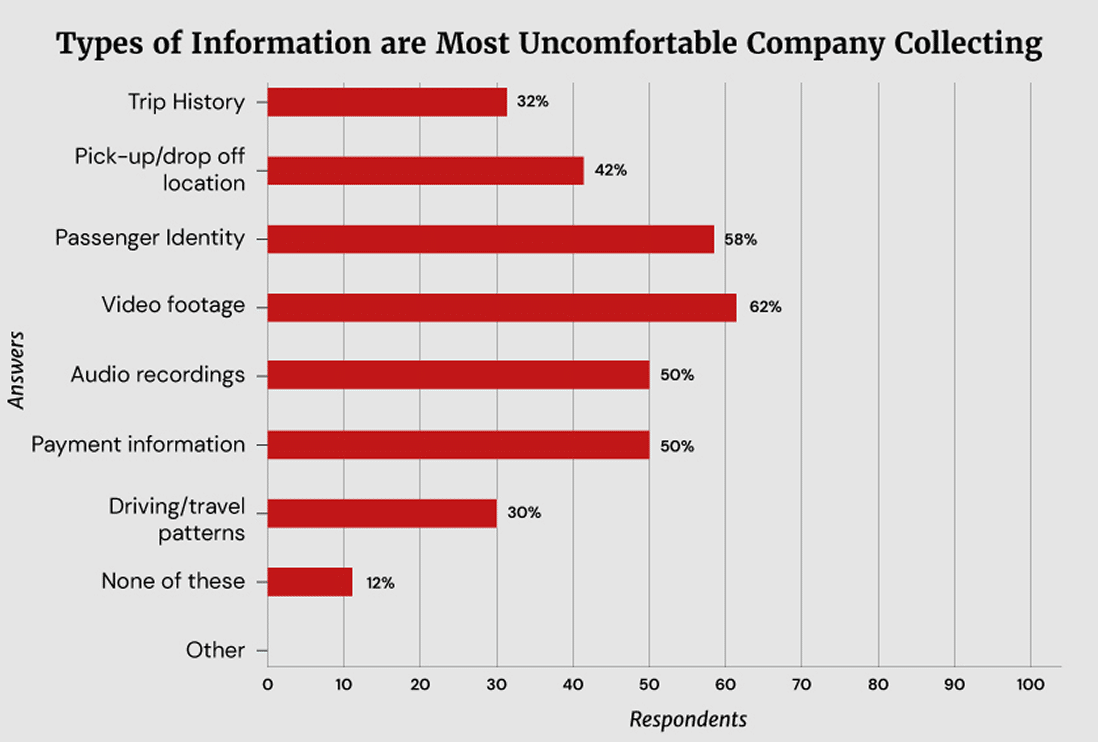
For respondents considering a driverless ride, privacy concerns range from who could access recordings from inside the vehicle to details about where they travel.
How Waymo Could Fit Into Existing Transportation Habits
Some respondents saw Waymo as another way to get around, alongside public transportation or rideshare services. Others considered replacing certain rideshare trips or avoiding the service entirely. When asked which trips they would consider using Waymo, 34% selected “I would not use a Waymo.”
For those open to trying it, interests included getting home after drinking and trips where parking is difficult. One respondent described a limited role:
“I would never want to fully utilize only Waymo, it may be on the side if I try it”
Another emphasized keeping existing options:
“So, maybe it could be part of public transit, but won’t replace it altogether.”
Together, these perspectives suggest room for Waymo to supplement transportation habits without becoming respondents’ default for every trip.
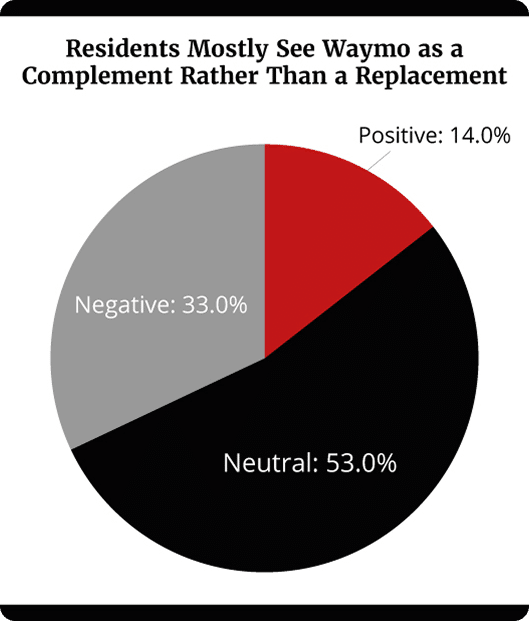
When Would Respondents Consider Using Waymo?
Getting home after drinking was the most selected potential use, followed by airport transportation and trips where parking is difficult. Respondents would consider Waymo for:
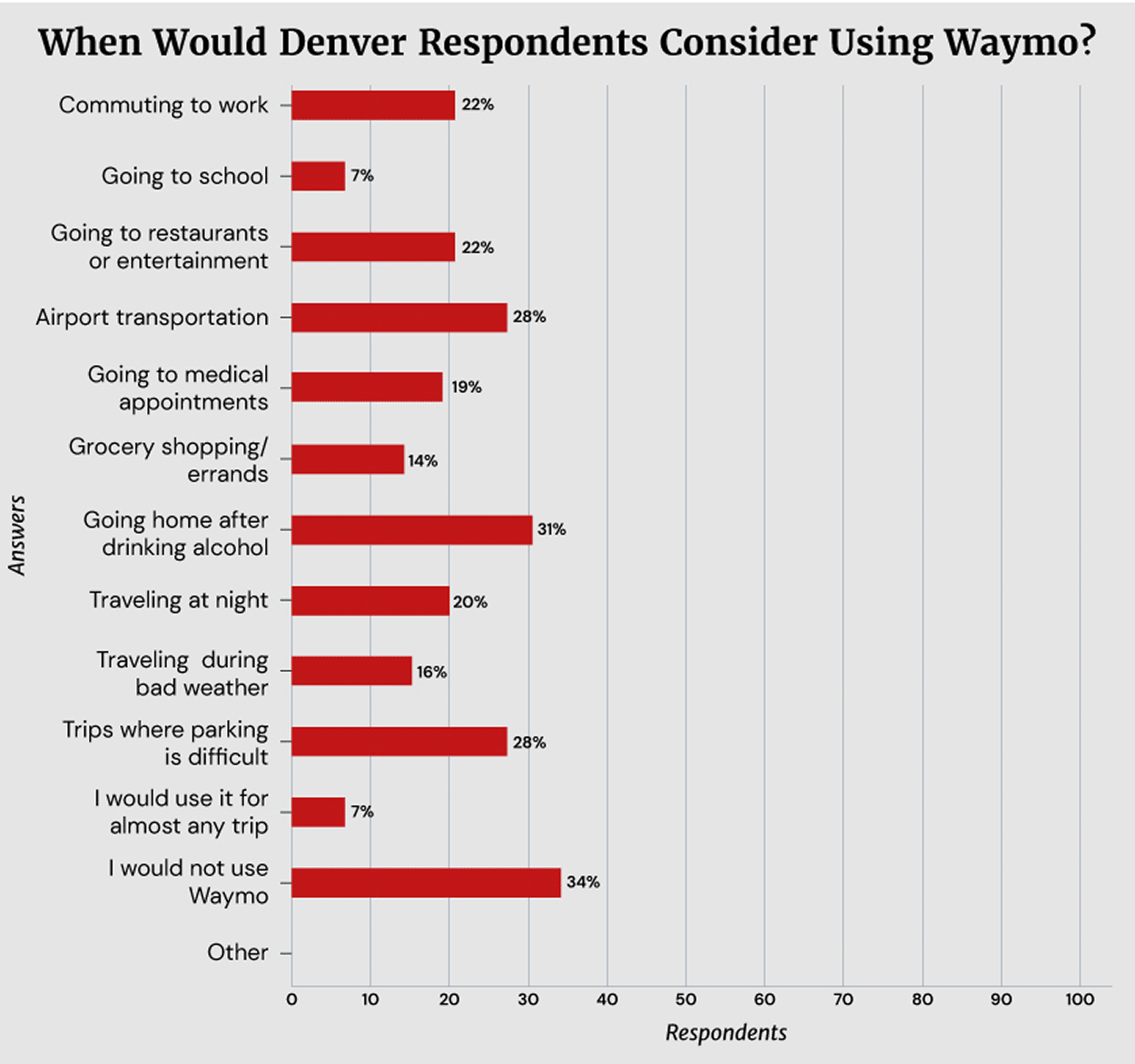
Interest centered on particular travel needs, with just 7% willing to consider Waymo for almost any trip.
How Waymo Could Impact Transportation in Denver
According to the survey, respondents were divided on how Waymo would affect existing transportation frustrations. Additionally, respondents could point to benefits and tradeoffs for using Waymo.
Traffic and Construction Shape Transportation Frustrations
Respondents described their frustrations with getting around Denver, including congestion and construction delays. Some also mentioned unreliable transit service, transportation costs, and poorly maintained roads.
One wrote:
“Traffic, due to construction, there is always a large amount of almost standstill traffic.”
Expectations that Waymo would ease congestion were limited, where 41% anticipated little or no impact, 29% expected congestion to increase, and 12% expected it to decrease. Another 18% said it was too early to tell.
Those concerns provide context for where respondents see potential value in Waymo. Even if it doesn’t solve the transportation problems they encounter daily, it can help with particular trips.
Where Respondents See Benefits and Tradeoffs
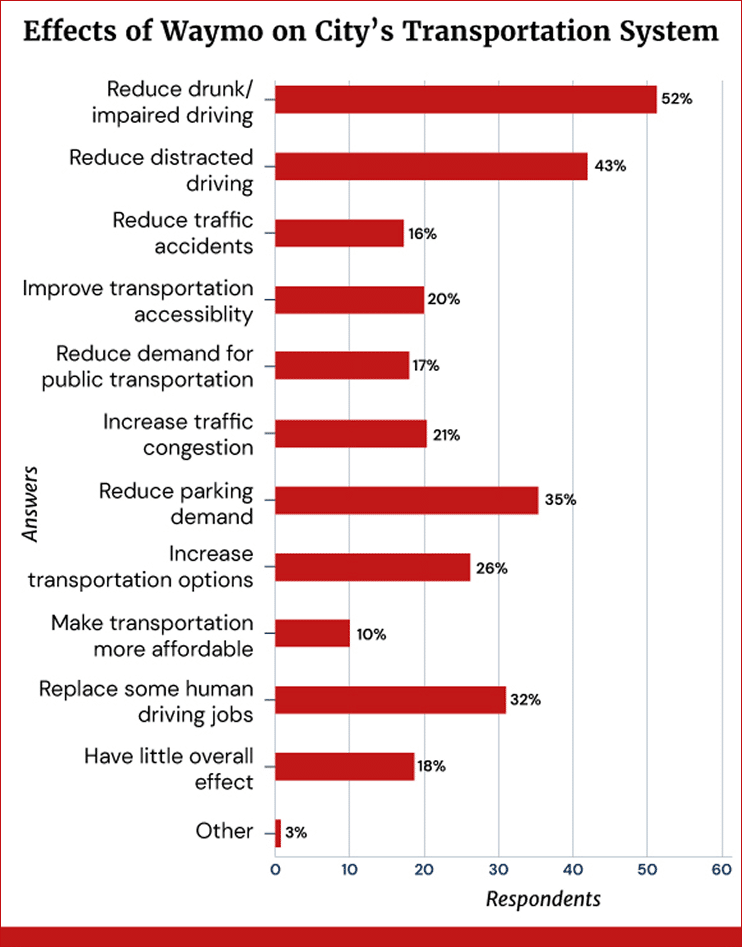
Respondents could point to benefits and tradeoffs. When it comes to getting home after drinking, 31% would consider Waymo, and 52% expected it to reduce drunk or impaired driving. Other anticipated effects included:
- Less distracted driving: 43%
- Reduced parking demand: 35%
- More transportation options: 26%
- Improved accessibility: 20%
- Reduced demand for public transportation: 17%
- More affordable transportation: 10%
Some respondents envisioned replacing rideshare trips with Waymo. Others suggested they would keep Waymo alongside their existing options. Respondents’ expectations emphasized specific safety and convenience gains, with fewer citing affordability or accessibility improvements.
Overall, 28% believed benefits outweighed risks. Expectations for citywide quality of life were mixed, with 36% selecting the midpoint on a scale from much worse to much better.
Denver’s Mayor Sees Long-Term Potential as Respondents Remain Cautious
In a September 24 interview with The Denver Gazette, Mayor Mike Johnston described Waymo as one part of Denver’s strategy to reduce traffic deaths. He cited its safety record and envisioned rides that connect people to public transit, reduce car ownership, and free parking lots for housing or businesses.
Respondents shared some of that optimism, with 52% expecting less impaired driving, and 35% anticipated reduced parking demand. Broader affordability gains drew less support, with 10% expecting cheaper transportation.
Johnston’s outlook focuses on what a wider adoption of Waymo could make possible. However, respondents’ answers reflect more immediate hesitation about riding and uncertainty about citywide benefits. As service expands, local safety performance and everyday experiences could help determine how much of that long-term vision takes hold.
What Could Shape Waymo’s Future in Denver?
Respondents saw reasons to consider Waymo, especially for getting home after drinking or avoiding difficult parking. Many also recognized potential reductions in impaired and distracted driving. However, concerns about safety and personal information remained, and enthusiasm for particular trips didn’t translate into a broad willingness to rely on the service.
Overall acceptance of Waymo was mixed, where 34% of respondents said they wouldn’t use Waymo, and 28% believed its benefits outweighed its risks. Others saw it fitting alongside the transportation they already use.
As Waymo expands in Denver, earning trust will involve more than offering another ride. Respondents identified how they would become more comfortable using the service, and cited clear safety data, transparent accident reporting, and positive community experiences.
If you were injured due to someone else’s actions, Olson Personal Injury Lawyers is here to help you file a personal injury claim. We’re prepared to guide you through every step of the process, from gathering evidence to representing you in court.
Our firm offers a free consultation to help you understand your options and next steps. Contact us online or call (970) 633-3673 to speak with a member of our team today.