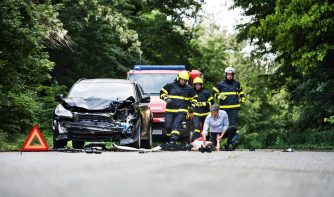

Car crashes remain the leading cause of accidental injuries in the United States. In Colorado, car accidents are a very serious issue. According to data cited by American Property Casualty Insurers (APCI), fatal car accidents in our state have risen to the highest level in more than a decade.
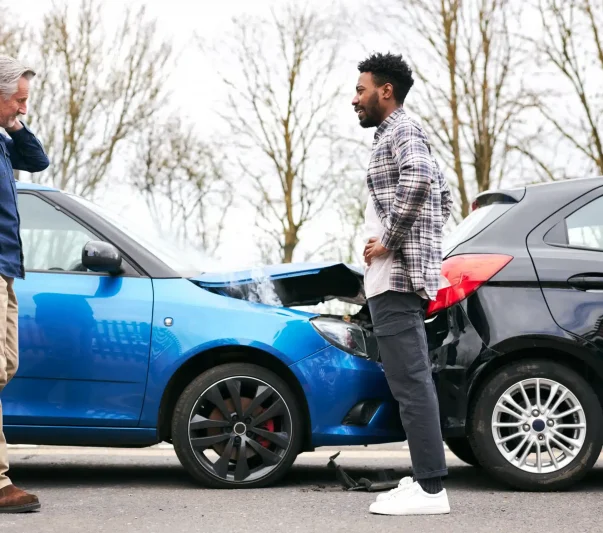
After a traffic collision, you will have many questions. One of the most important is: Who is at fault for the crash?
Key Takeaways
- Colorado is an “at fault” auto insurance state, meaning that to recover damages, you must prove the other party is responsible for the accident. If you’re found partially at fault, it can reduce the amount of your settlement, so establishing fault is critical.
- Negligence, such as speeding, distracted driving, or driving under the influence, determines fault in a car accident case. If you’re involved in a crash, it’s important to work with an attorney who can help prove that the other driver’s unsafe actions caused the collision.
- If you’re facing a car accident dispute in Colorado, consulting an experienced lawyer is crucial to securing full compensation.
Colorado is an ‘At Fault’ Auto Insurance State
In a Colorado car accident claim, fault matters. Like the majority of jurisdictions in the United States, Colorado is an ‘at fault’ auto insurance state. This means that injured victims can hold opposing parties legally liable for their damages only if they can prove that the defendant is actually to blame for the crash. If you cannot establish fault, or if you get unfairly blamed for your own wreck, it could take a lot of money out of your settlement offer.
Car accidents can cause life-altering injuries and leave you with significant financial burdens. If you’ve been hurt due to someone else’s negligence, you may have the right to compensation. Our car accident lawyers are here to help you get justice.
Negligence Determines Fault
Under Colorado law (C.R.S. § 13-21-111), negligence determines who is at fault. In legal parlance, negligence means the failure to take adequate care in a particular situation. All drivers have a responsibility to operate their cars in a reasonably safe manner. This includes following all relevant rules of the road.
When a driver violates one of the rules of the road or otherwise operates their vehicle in an unsafe manner, they are responsible for any damages that occur as a result of their negligent conduct. In car accident claims, negligence can come in many different forms. Some of the most typical examples include:
- Speeding or driving too fast for the weather;
- Following another car too closely;
- Running red lights or stop signs;
- Failure to yield or failure to merge safely;
- Unsafe lane changes or other forms of reckless driving;
- Distracted driving, including texting and other cell phone use; and
- Intoxicated driving, including drunk driving and drugged driving.
To establish negligence, a car accident victim must be able to establish that another party engaged in unsafe conduct and that their unsafe behavior actually contributed to the accident in question. This is not always an easy task. As such, injured victims need to be ready to seek legal representation.
Common At-Fault Car Accident Scenarios
Car accidents can happen in many different ways, but some crashes are more commonly caused by driver mistakes or unsafe behavior. Here are some common accident scenarios where another driver may be at fault.
Who Is at Fault in a Lane Change Accident?
Lane change accidents are usually caused by one driver failing to see another vehicle in their blind spot. When this happens, the driver moves over, thinking the way is clear—but it isn’t.
Are they at fault? Yes.
A driver making a lane change is responsible for ensuring no one is in their blind spot. They should use their mirrors, turn their head, look over their shoulder, and adjust their speed to change lanes safely.
When the Other Driver Admits Fault
If the other motorist tells the responding officer they didn’t see you, this will usually make your insurance claim much easier. They’ve essentially admitted that they didn’t do an adequate job of checking their blind spot before making the move.
However, the insurance company could still claim you had some responsibility under comparative negligence, so we will work to show you were not at fault.
When Accounts of the Crash Conflict
But not every case is as straightforward as when the other driver admits fault. Sometimes, the other driver has a story that doesn’t match your recollections.
For instance, they might tell the officer that you were getting over into their lane, making the accident your fault. To make matters worse, the evidence at the scene might not help much—if there is damage to the side of each car, it could be difficult to tell who moved into the other party’s lane.
When there are no other witnesses, the police officer may have to make an educated guess about who was at fault. Or, they might not cite anyone if the fault is unclear.
Who Is At Fault For Left-Turn Car Accidents in Colorado?
In most cases, the driver turning left is considered liable for the collision. That’s because Colorado law requires drivers turning left to yield to oncoming traffic. However, there are exceptions to this presumption in which other drivers may be at least partly at fault.
A Colorado car accident lawyer can help you determine who was legally responsible for your crash and what your legal options are to recover compensation based on your crash cause.
What Colorado Laws Apply to Drivers Turning Left?
Specifically, Colorado Revised Statute section 42-4-702 requires a driver turning left to yield the right-of-way to oncoming traffic. Also, C.R.S. 42-4-903 prohibits vehicles from turning unless they are properly positioned on the road. This law also requires drivers to use their turn signals at least 100 to 400 feet before the turn, depending on the road type.
If a driver turning left violates these safety rules, it can help demonstrate that they were negligent in keeping other drivers safe on the road. If crash victims can prove their injuries resulted from the driver’s negligence, they may be able to make an injury claim.
Exceptions to the Left-Turn Fault Rule
While the driver turning left is often to blame for the accident, there are some exceptions. All motorists have a responsibility to behave safely on the road. Other drivers may share fault or may even be fully at fault for a left turn crash if:
- They were speeding, which made it difficult for the left-turning driver to judge their distance.
- They ran a red light or a stop sign and entered the intersection illegally, even though the driver turning left had the right of way.
- They were driving recklessly or aggressively, and they entered the intersection while a left-turning driver was turning or had the right-of-way.
- They didn’t use headlights when required, making it harder for the other driver to see them.
- They unexpectedly changed lanes and moved into the path of the turning driver.
Evidence That Can Be Used to Determine Fault
In some cases, the parties disagree about who was to blame for a crash. If there is a dispute about car accident fault, you must be able to prove the other driver was to blame. A variety of evidence can be helpful in these situations.
Reporting a car accident in Colorado is important because the police might conduct an investigation. A police report is helpful evidence and includes witness contact details and other information about the likely causes of the crash.
Our legal team at Olson Personal Injury Lawyers will obtain police reports and other evidence on your behalf, including any video footage of the accident scene from traffic cameras or security cameras. We will also obtain pictures from the crash scene, witness testimony, cell phone records, toxicology reports, and, if necessary, expert testimony from crash reconstruction experts.
Event Data Recorder (EDR) Evidence
If video and witnesses are unavailable, we may request data from each vehicle’s event data recorder or EDR. These devices are built into most modern vehicles as a way for car manufacturers to study accidents and improve safety.
However, their data is often useful in car accident cases.
An EDR records a vehicle’s speed and direction and any actions the driver made before or during the collision. As a result, we may be able to use this information to show which vehicle was changing lanes and which was already in the lane.
Questions About Fault? Call a Denver Car Accident Lawyer
If you are suffering from a major car crash, and there is a dispute over who is at fault for the crash, it is imperative that you consult with an experienced Denver auto accident lawyer immediately. Your ability to recover full and fair compensation for your damages relies on establishing fault. You should not have to pay for the negligent action of another driver.
At Olson Personal Injury Lawyers, our legal team has deep experience handling complex car accident claims. We know how to investigate accidents, review evidence, and build strong legal cases. We have helped many injured victims get full financial compensation for their losses. If you are suffering from a car accident in Colorado, give our law firm a call. We would be happy to take some time to review your claim and explain your legal options to you.