
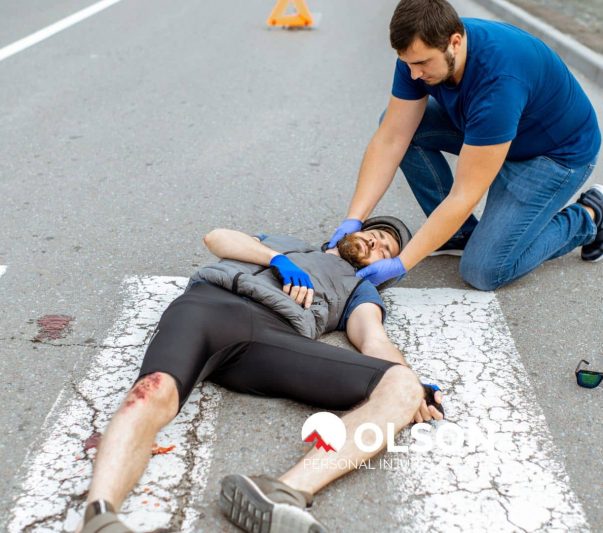

Careless drivers, pedestrians, or other negligent parties may be responsible for a pedestrian crash. However, determining who is at fault after a pedestrian accident in Colorado is a complex process, often leaving drivers and pedestrians uncertain about their degree of responsibility.
Although many people assume the driver is always at fault for a pedestrian accident, that’s not always the case. Colorado pedestrian accident liability depends on the cause of the crash. If you have questions about fault and who can be held responsible for your injuries, contact our Denver pedestrian accident lawyers for a free consultation.
Key Takeaways
- Colorado drivers and pedestrians have a legal duty to use reasonable caution. Failing to do so could make them legally responsible for a resulting accident.
- Even if an injury victim shares fault for the accident, they may still be eligible for compensation under Colorado’s modified comparative negligence system.
- A trusted pedestrian accident attorney can help you navigate the claims process, determine liability, and recover damages.
How Is Fault Determined in a Colorado Pedestrian Accident?
When determining pedestrian accident fault in Colorado, you must establish all elements of negligence, including:
- Duty of care: First, you show there was a legal duty to act with reasonable care.
- Breach of duty: Next, you need to prove that the at-fault party failed in their duty of care.
- Causation: The breach of duty must be the cause of the pedestrian accident.
- Damages: Lastly, the accident must result in damages, such as medical bills.
You may be entitled to compensation for your financial losses and suffering if you can prove that negligence led to the accident. This process involves conducting an investigation and collecting evidence that can determine fault, including:
- Police accident reports
- Photos and videos from the accident scene
- Surveillance or traffic camera footage
- Witness statements
- Cell phone records
- Traffic signal timing records
- Medical records
Who Is at Fault if You Hit a Pedestrian in Colorado?
When a pedestrian is hit by a car, who is at fault will depend on the details of what led up to the accident. In some cases, the injured pedestrian may have caused the crash by acting recklessly, or the driver may be at fault for violating Colorado pedestrian laws.
Here are examples of situations where the driver, pedestrian, or both may be legally and financially responsible for damages following a pedestrian accident.
When Drivers Are Found at Fault
Drivers have a duty to operate their vehicles safely and follow Colorado traffic laws, including C.R.S. § 42-4-802, which requires drivers to yield the right of way to pedestrians in a crosswalk. If they fail to do this and hit a pedestrian as a result, they can be held liable.
Behaviors that may lead to driver liability include:
- Failing to yield to pedestrians
- Driving while texting or distracted
- Driving above the speed limit
- Running red lights or stop signs
- Driving under the influence of alcohol or drugs
- Making turns without slowing down for pedestrians
- Pulling out of alleys or parking garages without checking for pedestrians
When Pedestrians Can Be Found at Fault
While motorists must use reasonable care when driving, pedestrians also have a responsibility to exercise caution while walking. A pedestrian can be at fault in Colorado if their careless or reckless actions led to the accident.
Examples of negligent pedestrian behaviors include:
- Jaywalking or crossing outside of marked crosswalks
- Ignoring pedestrian traffic signals
- Suddenly stepping into traffic
- Crossing the street while distracted
- Walking on the road while intoxicated
Certain unlawful acts can make pedestrians liable for causing an accident, including jaywalking, which C.R.S. § 42-4-803 states is a Class B traffic infraction in Colorado.
Accidents happen, but when they’re caused by someone else’s carelessness, you shouldn’t have to bear the burden alone. Our experienced personal injury attorneys are ready to fight for the compensation you deserve.
When Both Parties Share Fault (Comparative Negligence)
Sometimes, both the driver and pedestrian share fault for the accident. Colorado applies modified comparative negligence to pedestrian accidents, allowing victims to claim compensation—even when they are partly to blame for what happened. However, you cannot be more than 50% at fault, and the amount you recover is reduced by your percentage of fault.
For example, an injured pedestrian is awarded $100,000 for damages after an accident but was also found to be 20% at fault. Under Colorado modified comparative negligence, the $100,000 is reduced by 20% to $80,000.
What Should You Do After a Pedestrian Accident in Colorado?
If you are hurt in a sudden pedestrian accident in Colorado, whether as a driver or pedestrian, here are steps you can take to get the help you need and protect your legal rights:
- Stay at the scene: Remain at the scene of the accident to exchange information.
- Call 911 and report the accident: Call 911 to report the accident to the police and request assistance.
- Document the scene: Take pictures and videos of the crash site and gather witness contact information.
- Seek medical attention: See a doctor right away to treat and document your injuries.
- Avoid admitting fault: Be careful about saying anything about the accident that could be interpreted as admitting fault.
- Report to your insurance: Inform your insurance company about the details of the accident.
- Contact an attorney: Speak with an experienced pedestrian accident lawyer to learn more about your legal options.
What Compensation Can You Recover After a Pedestrian Accident?
A pedestrian accident can result in severe injuries that put physical, financial, and emotional hardships on you and your loved ones. By taking legal action, you may be entitled to compensation for economic and non-economic damages.
Economic damages are the measurable financial losses caused by the accident, such as:
- Medical bills
- Cost of future medical care
- Lost wages
- Loss of future earnings capacity
- Property damage
- Other out-of-pocket expenses
Non-economic damages are the intangible ways your quality of life if affected by what happened, including:
- Pain and suffering
- Emotional distress
- Mental anguish
- Loss of enjoyment of life
- Permanent disability or disfigurement
Colorado law places a cap on non-economic damages, which is adjusted periodically and depends on the type of claim. For many personal injury cases filed after January 1, 2025, that cap is approximately $1.5 million.
Get Help After a Colorado Pedestrian Accident
Knowing who is at fault after a pedestrian accident in Colorado could mean justice and financial relief for struggling victims and their families. If you were injured in a pedestrian crash, Olson Personal Injury Lawyers can help you pursue compensation and hold the at-fault party accountable for their negligence.
Our team provides unrivaled representation in and out of courtrooms, protecting you from aggressive insurance companies that try to pay less than your claim is worth. When you need us, we are here. Call (303) 381-2234 or contact us online today to schedule your free consultation with our team.
